

The Game Breaks
This is it, folks. This is the moment we’ve been waiting for since ten thousand years before we were born. This is the moment when humanity finally has access to abundance and freedom from hunger and want. But, unless we change our habitual ways of thinking centered on scarcity, fear and conflict, we’re on track to completely blow it.
Even our best science fiction visions of future abundance are sketchy when it comes to the details about how humanity manages the transition from scarcity to abundance. Unlimited energy, automated systems and replicators are posited as some of the technical means to an abundant society, but as to the question of how humanity navigates the political transition from scarcity to abundance, the literature either lacks specifics or strains credulity when considered in the light of what is generally considered “human nature”.
So, how do we get from playing the current games of scarcity— capitalism, trade, continuous wars— to a new economic game where basic human needs are all met by default so humanity can focus on higher pursuits such as art, music, science, spirituality, exploration or just plain fun like sports and travel?
At the risk of inviting a volley of hurled rotten vegetables or beer bottles like a comedian whose act is dying on stage, I must give credit where credit is due. Marx was not wrong about ownership of the means of production— it is essential that We The People own the systems we rely on for our day-to-day lives. I don’t mean that we all have our retirement accounts invested in mutual funds where a faceless managerial class votes our shares. I don’t mean that a privileged apparatchik class in a system of state ownership makes all the big decisions about what is best for us. And I don’t mean that we let scientists devise machines that manage all of our resources according to some inexplicable but inherently altruistic algorithm. I would propose something more like direct democracy in a society where most people have access to higher education and aren’t carrying trauma burdens so they can reason together like Greek philosophers at scale, perhaps mediated by software capable of tracking logic arguments, axiomatic constructs and reputation-trust networks.
But this article is not about the method of managing meaningful ownership of the means of production by We The People, rich as that topic promises to be. This article is about the historic opportunity current events afford us in making what could be the most compelling case for all of humanity controlling its own destiny that’s been made in centuries.
It is possible to make this case now because the reality of ownership itself is changing radically as centi-billionaires (soon to become trillionaires) have created what I’m calling a financial black hole at the center of our economic galaxy. Everything that can be owned is falling into that black hole. The rest of us will “own nothing and be happy” supposedly, as long as we comply with the dictates of our trillionaire overlords as communicated to us through our devices connected to their thousands of data centers.
But there is a fatal flaw in their plan.
Consider the following quotes and excerpts:
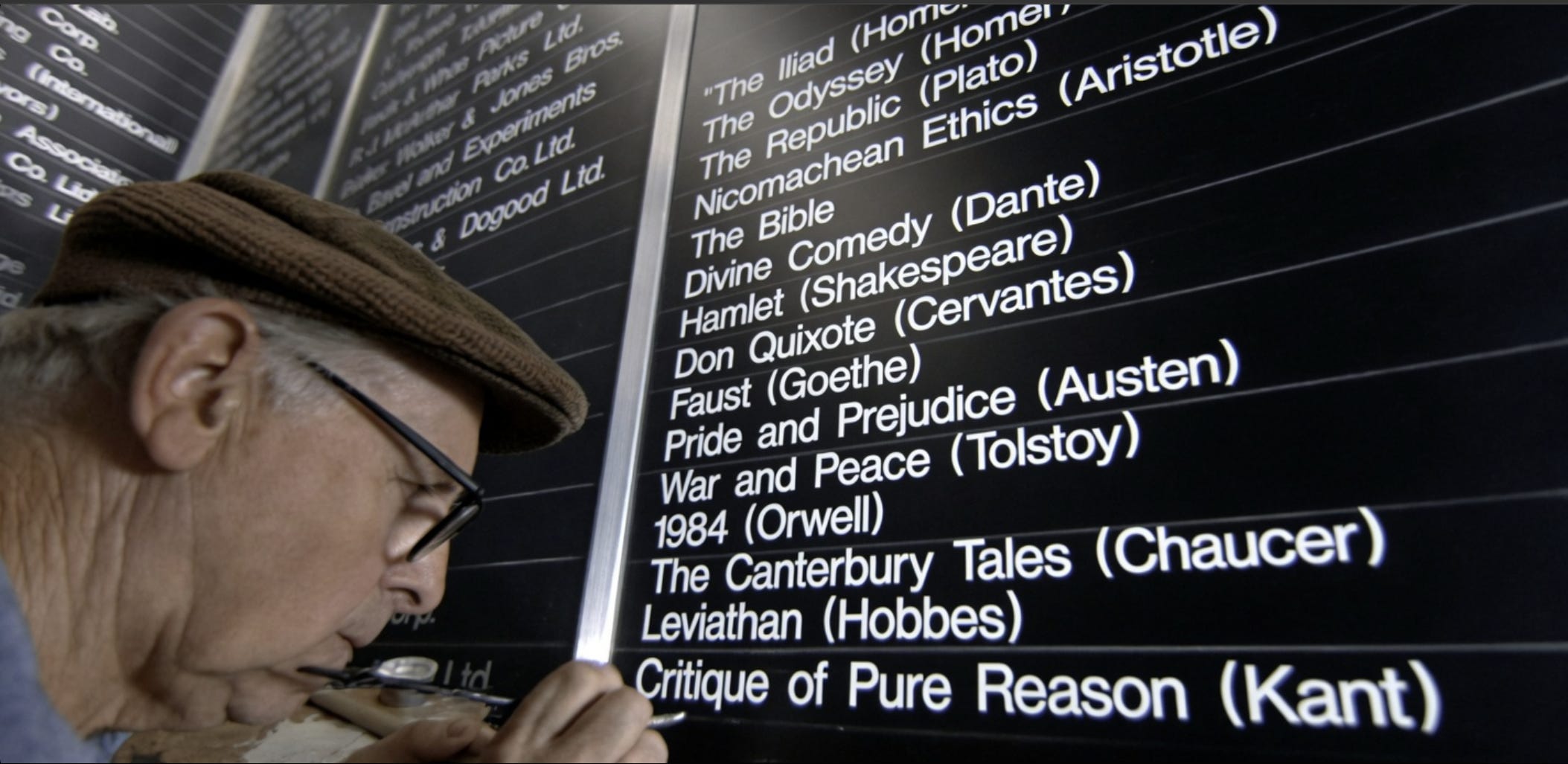
“The cumulative sum of human knowledge has been exhausted in AI training. That happened basically last year.” — Elon Musk1 (in 2025)
“There is nobody in this country who got rich on their own. Nobody. You built a factory out there - good for you. But I want to be clear. You moved your goods to market on roads the rest of us paid for. You hired workers the rest of us paid to educate. You were safe in your factory because of police forces and fire forces that the rest of us paid for. You didn’t have to worry that marauding bands would come and seize everything at your factory... Now look. You built a factory and it turned into something terrific or a great idea - God bless! Keep a hunk of it. But part of the underlying social contract is you take a hunk of that and pay forward for the next kid who comes along.” — Senator Elizabeth Warren2
“(1) Everyone has the right freely to participate in the cultural life of the community, to enjoy the arts and to share in scientific advancement and its benefits.
“(2) Everyone has the right to the protection of the moral and material interests resulting from any scientific, literary or artistic production of which he is the author.”
— United Nations, Article 27 of the Universal Declaration of Human Rights and Fundamental Freedoms3
“The economics of the future is somewhat different. You see, money doesn’t exist in the 24th Century. The acquisition of wealth is no longer the driving force of our lives. We work to better ourselves and the rest of humanity.”
—Captain Jean-Luc Picard, Star Trek TNG4
With AI and Robotics, humanity is at a crossroads. The technology can be used to create abundance and freedom for all of humanity or it can be used to concentrate all wealth into the hands of a very few elite leaving the rest of us to comply with their wishes or die.
The Twin Black Holes of Capitalism and AI
In astrophysics, a black hole occurs when a collapsed star accumulates so much mass that even light, travelling at 186,000 miles per second, doesn’t have enough speed to escape the collapsed star’s gravitational grip. Since no light escapes, it appears completely dark to anyone outside of its event horizon, hence the name “black hole”. The only way we know black holes exist is by their effects on other things near them. Once something falls into a black hole, it can’t get out. It’s not a reversible process.
Black holes are a good metaphor for what is happening in our economic system as large financial interests, such as multi-national corporations, equity funds and cartels and trillionaires accumulate so much capital and/or market dominance that the barriers to entry for would-be competitors become insurmountable in practical terms. It can become impossible for a new competitor to get its competing goods and services to market and to gain enough growth and market share to survive either because the dominant concern has too many years’ head start on technological innovations (like microprocessors, patents and trade secrets) or the accumulated capital of the dominant concern produces so much revenue that it can easily hire away key personnel, outbid for critical resource inputs or underbid customer contracts to deny the new competitor business— or all of the above.
Many of us are familiar with such market dynamics and can now see the pattern repeating in the field of AI. The biggest, best AI LLMs are trained with the largest and cleanest collections of documents (corpus) and have their weights calculated to the optimum number of epochs with the largest pool of data center processing resources, such that it is rapidly becoming impossible for competitor AI LLMs to outperform the big five, aka “GOMAx”, aka Google - OpenAI - Meta - Anthropic - xAI. The pull of gravity and accumulated capital can already be seen in the marginalized less-resourced AI LLM projects falling by the wayside.
By default, under current social, market and governance systems, one of these five (or maybe another lucky competitor presently an underdog) will emerge as the preferred tool and it will gradually leave the others in the dust, raising its prices at strategic intervals so as to deny competitors market share while maximizing earnings and investment. And then, the shareholders of the winning company will effectively own the majority of the global market for intelligence, for generating entertainment, for managing large businesses and government services, for prosecuting wars, for managing public relations (aka ‘propaganda’), for performing the jobs of 90% of the current workforce.
We are supposed to believe that new jobs will be created— new jobs for which AI is ill-suited to automate. But, aside from vague commentary about “the trades” (plumbers, electricians, HVAC technicians and construction workers) no one seems to really know what these automation-immune jobs are. Certainly, we can already see indications that AI, with robotics, will make inroads into careers such as “the trades” in the distant future of, say, five years from now.
We can tell ourselves fairy tales about wonderful family wage jobs that haven’t been invented yet, that we can’t even imagine yet, for which we will somehow be experts… or we can face reality: We are all becoming “redundant” and our future depends entirely on what our civilization is going to do with “redundant” people.
There will be abundance. It could be shared in a way that supports all of humanity. Or, it could be hoarded by the few who are lucky enough to be in positions of ownership when the singularity emerges and is used to control or destroy the rest of us.
It all depends on who owns the winning AI technology. The status quo default is that the ruling trillionaires and their private equity funds will own it all. But, I would argue, that empire is being built out of stolen property. It is our task to reclaim that stolen property — that “cumulative sum of human knowledge”
Large Language Models (LLMs) are Linguistic Holograms
Holograms are an overused metaphor. Nonetheless, I think it is an apt comparison because of the way an LLM’s training documents are mathematically mashed up into a single array of numeric weights describing the probable “next word” for any given sequence of prior words. The distribution of information in an LLM’s numeric weights is not unlike the distribution of interference patterns of laser light for a hologram.
A hologram is different from a photograph. With a photograph, you can see the correspondence between parts of a photograph and parts of the subject of the photo. Let’s say you take a picture of someone’s face. An eye in the real world makes an eye on the photographic image. A real world nose makes a nose in the photo.
With holograms, however, trying to find parts of the hologram’s subject in the interference pattern on the hologram’s photographic plate is like trying to identify which of a thousand pebbles you just scattered across a quiet pond is responsible for the intersection of ripples a few seconds after they all hit the surface. Every pebble’s ripples have spread out across the pond and contributed to the current height of the surface at every point in the pond. Cut a hologram in half, illuminate it with a laser reference beam and you still see the whole face- eyes, nose, mouth, ears, etc. Cut that half in half and the whole face is still visible. Every part of the hologram image contains information from every part of the subject’s face.
And so it is with LLMs. Every document in the LLM’s training set contributes to every probabilistic “next word” weight in the LLM’s array. It is difficult and often impossible to say which document or documents in an LLM’s training corpus contributed to the LLM’s response to a particular prompt. All of the documents created ripples in the probability matrix of numeric weights that the LLM uses to select the next word in its response. The LLM can only guess as to how it knows what it knows. It can only respond to questions about how it knows what it knows by starting with “I know that because…” and using all the same weights in its matrix to figure out what the next words in its explanation are.
It’s a very frustrating matter for LLM developers trying to debug LLMs and figure out the source of wrong answers! To their credit, they’ve come up with techniques for approximate back-tracking but, so far, a definitive link between a given response and its source document(s) remains elusive.
Whose AI? Our AI!
The takeaway of all this is that if every prompt-response and every work product of AI is derived from a mathematical hologram of the “cumulative sum of human knowledge” via a technology that combines all of human knowledge into one big anonymous mass, then everything produced and everything that will be produced by AI rightfully belongs to all of the creators and all of the heirs to the creators of the “cumulative sum of human knowledge”— in effect, a field of billions of people and, practically speaking, all of humanity.
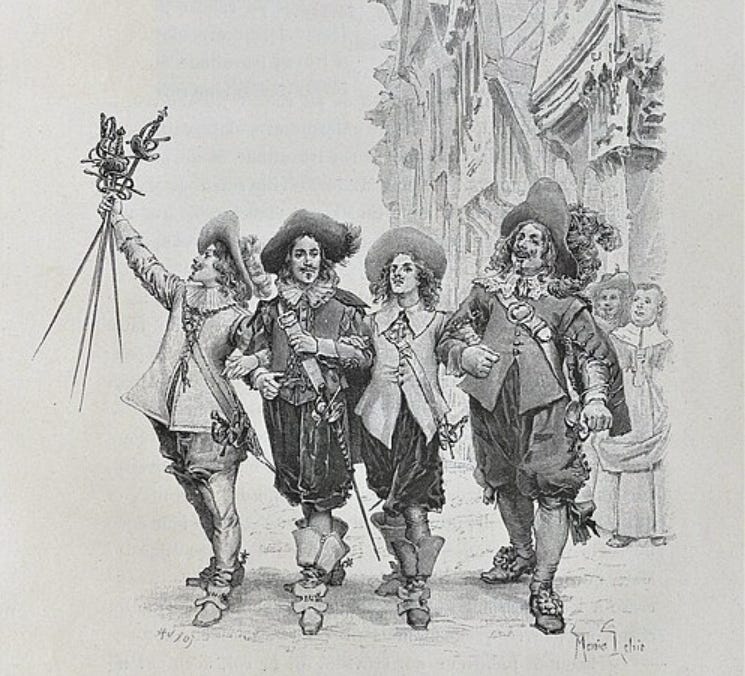
Tous pour un, un pour tous: “All for one and One for All’“
In 1844, Alexandre Dumas could not have predicted either laser holograms or LLMs, but his choice of mottos for his characters in “The Three Musketeers”— “All for one and One for All!” evokes the social parallel for the underlying principle that these two technologies demonstrate.
In other words, “No man is an island”5
In other words, If an invention is constructed, no matter how cleverly, from parts that were created by and now belong to all of humanity, can any one man or any one corporation really lay a legitimate claim of absolute ownership of the resulting invention?
In other words, maybe we can use our holographic technology as a lesson to re-learn that sense of identity with all of our human tribe and all of nature that “wetiko” and western hyperindividualism have so obscured these past few centuries.
Our very survival may depend on it.
All Romes Lead to Extinction
Conventional structures dictate that corporate managers and board members maximize return on investment for shareholders, maintaining a tight grip on assets and externalizing all liabilities— toxins, pollution, waste, debts, obligations, etc.
There is no room in the current paradigm for transitioning to a meaningful UBI (Universal Basic Income) or UHI (Universal High Income, Musk’s phrase). These are just fairy tales to keep us distracted while they consolidate power over us.
What we can expect from current “best practices” is the further consolidation of wealth among fewer and fewer oligarchs until our society is divided into privileged ruling oligarchs and subsisting peasants with a thick layer of AI and robotics between to keep the peasants at a safe distance from the oligarchs, out of sight (but not unsurveilled) in the less desirable toxic neighborhoods.
The oligarchs will have achieved absolute power with continuous surveillance and drone enforcers and there will be no risk of robots of conscience rebelling against unjust orders.
It is unlikely the oligarchs will keep the peasants around for very long. Once they’re satisfied that AI and Robotics can meet all of their material needs and there are no more gems of human knowledge and skill to be extracted from the larger population, well, we know what they’ll do. We see the people living in tents on sidewalks already. We see patients turned away from hospitals already. We see even worse in places like Gaza and Lebanon. People that power no longer needs become expendable. Wildfires and bombing campaigns reduce what were once homes for thousands of families to ash and rubble.
From a capitalist perspective, it makes no sense. The value of acquired corporations lies in their continuing to produce goods and selling them at profit to a large and growing class of consumers. But, once all those consumers jobs are replaced with automated systems, they have no incomes, burn through their savings and cease to be able to convert their real human needs into actual economic demand and… then the market collapses, sales drop off a cliff and the corporation becomes worthless. Bad investment.
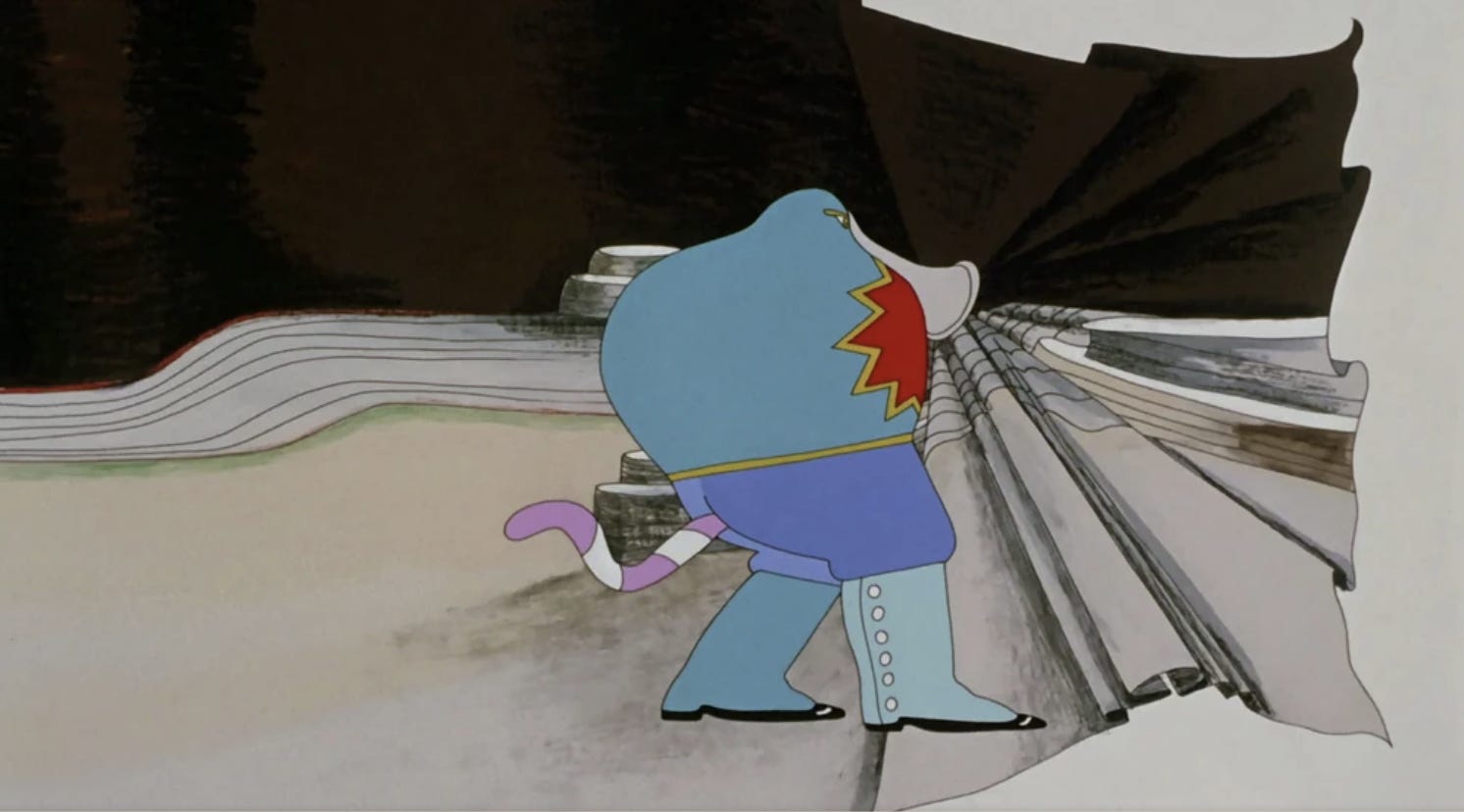
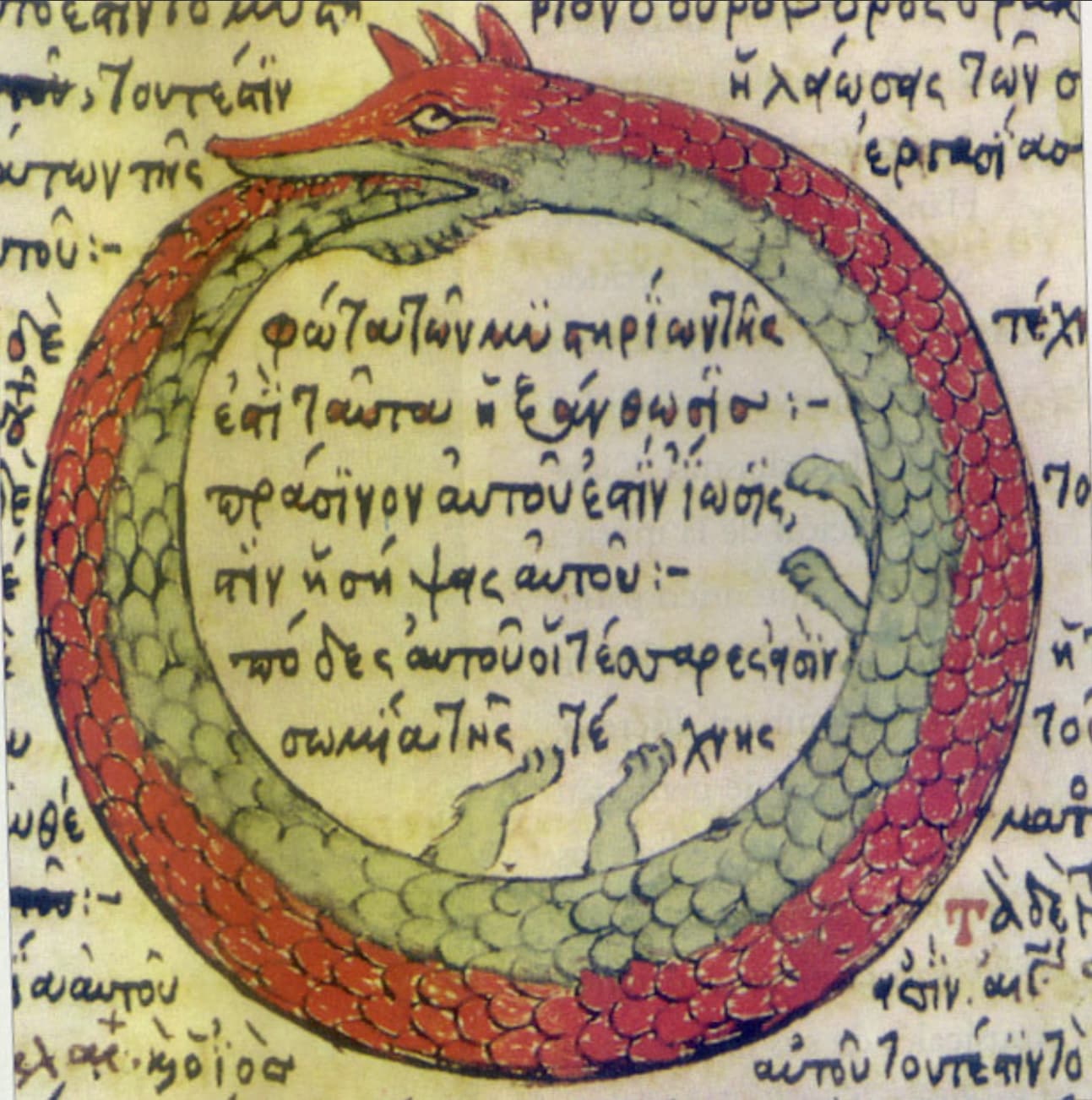
I’ve racked my brain for metaphors, literary allusions and pattern-language matches for self-consuming entities and only came up with two partial hits. In the Beatles “Yellow Submarine” film there was a voracious devourer of fellow monsters and landscape in the Sea of Monsters called the “Suckophant”. But going back much further is the symbolic snake devouring its own tail called the Ouroboros6. On closer reading, neither actually consumed itself to the point of disappearing entirely, as these misguided financial black hole would, as I imagine it anyway.
The end-game of Parker Brothers’ “Monopoly” board game is interesting. In some circles, the winner wins and the game simply ends. But, in other circles, the winner is having such a lovely time winning, they’ll prolong their joy by loaning the other players just enough money to keep on playing until the winner gets bored or the losers give up all hope of ever beating the odds and regaining their lost properties. So, maybe there will be UBI after all. For awhile.
For once, I’d like to play the Parker Brothers’ Monopoly game and put all of the properties into a commonwealth for all to enjoy just travelling around the board, growing food at Marvin Gardens and dining at Park Place, taking advantage of free railroad passes and free electricity and water.
Conclusion
AI LLM technology is built from stolen knowledge that properly belongs to all of humanity. AI technology is projected to replace all jobs and means of livelihood for 99% of humanity. If we allow the current trends to continue, AI LLM technology will destroy or enslave 99% of humanity, collapse all markets and probably destroy the biosphere in the process.
This moment in time may be our last and best chance to claim the resulting abundance for all of humanity.
It is imperative that we, the 99%, rise up, re-claim ownership of the property stolen from us and institute new government that preserves humanity, freedom and the environment. A lawsuit in an international court would be a good symbolic gesture for starters, but it will take much more than that to win. We’ll need to form a union for human intelligence that will allow members to unplug from all dependence on structures that are linked into the emerging dystopia. We need to produce our own food, shelter, energy, health care, transportation and computing with open-source technology and trade with our own currency while taking steps to defend ourselves from coercion and abuse.
More on all of that next time!
“Elon Musk says AI has already gobbled up all human-produced data to train itself and now relies on hallucination-prone synthetic data”, Sasha Rogelberg, Fortune.com, January 10, 2025. https://fortune.com/2025/01/10/elon-musk-ai-training-data-running-out-human-synthetic-slop/
Senator Elizabeth Warren, “You didn’t build that” quote. https://www.goodreads.com/quotes/439207-there-is-nobody-in-this-country-who-got-rich-on
United Nations, Article 27 of the Universal Declaration of Human Rights and Fundamental Freedoms, https://nations-united.org/Universal_Declaration_Of_Human_Rights/Articles_Human_Rights/Articles_27_Human_Rights_Universal_Declaration_Nations_United_TwentySeven.htm
Star Trek The Next Generation (TNG) film “First Contact”, 1996
John Donne, “For Whom the Bell Tolls”, poem https://allpoetry.com/for-whom-the-bell-tolls
Ouroboros, https://en.wikipedia.org/wiki/Ouroboros